Grow Room Ventilation: Sizing Extraction Fans, Intake and Air Circulation
Multiply your tent's volume in cubic metres by 60 for one full air change a minute, then add headroom for the carbon filter, ducting and grow-light heat. Pair the extraction fan with a larger intake opening and a circulation fan or two; a speed-controlled EC fan is the best buy.

On this page
Sizing grow room ventilation? Work out your tent's volume in cubic metres, multiply by 60 for one full air change a minute, then compound the headroom: ×1.6 for a carbon filter, ×1.2 for ducting and up to ×1.5 for grow-light heat. Pair that extraction (outtake) fan with an intake opening 1.5-2 times the area of your exhaust opening, plus a circulation fan or two inside. For most UK growers, a speed-controlled EC fan is the best buy.
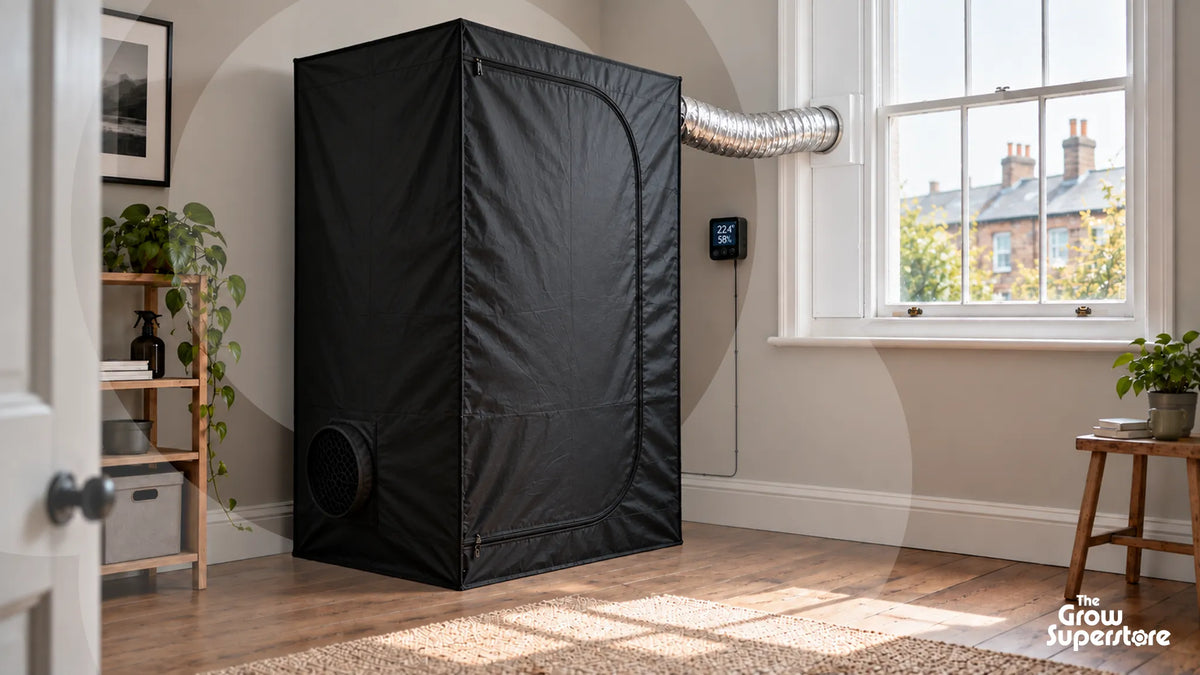
An extraction fan — also called an extractor fan, outtake fan or inline duct fan — is the powered fan that pulls warm, stale air out of a grow room through ducting, usually via a carbon filter. Get it right and it solves three problems at once: heat (it's your main cooling tool, holding the tent at roughly 20-28°C (68-82°F) — see our grow tent temperature guide), humidity and stale, CO₂-depleted air.
Who this guide is for: UK home growers choosing or upgrading a tent's extraction, intake and circulation fans, and anyone whose setup runs hot or damp.
AC, DC or EC fan — what's the difference for a grow tent?
An AC fan uses a mains induction motor; an EC fan pairs a brushless DC motor with onboard electronics that run it straight from the mains. In practice, "DC fans" in a grow shop means EC inline fans plus genuine low-voltage DC circulation fans.
Fan maker Orion Fans puts brushless DC/EC motors at up to 30% more efficient than AC motors. Since a well-sized fan runs at part speed most of the year, that matters: turned down, an AC fan on a cheap controller can hum, while an EC fan stays smooth and quiet.
| AC inline fan | EC inline fan | DC circulation fan | |
|---|---|---|---|
| Motor | Mains induction motor | Brushless DC motor with onboard electronics, mains-powered | Low-voltage brushless DC |
| Speed control | External triac/voltage controller (Systemair lists the RVK as triac or voltage controllable) | Built-in stepped control; the Phresh HyperFan Silenced V2 ships with a speed controller | Built-in — DC circulators typically offer multiple speeds with a wireless remote |
| Example at TGS | Systemair RVK Sileo | Phresh HyperFan Silenced V2 | Tornado DC fans |
One caveat: match the controller to the motor. AC fans take triac or voltage controllers; EC fans need the digital controller their manufacturer specifies — never a plug-in dimmer. See fan speed controller types.
What size extractor fan do I need for my grow tent?
Use your tent as the calculator. Multiply length × width × height in metres by 60 for a baseline m³/h (in feet, cubic feet = baseline CFM) — one full air change a minute. Then, per AC Infinity's sizing guidance, compound the allowances for everything that resists airflow: multiply by 1.6 for a carbon filter, 1.2 for ducting, 1.2 for a silencer if fitted and up to 1.5 for grow-light heat.
Worked example: a 1.2 m × 0.9 m × 1.8 m (about 3'11" × 2'11" × 5'11") tent holds 1.94 m³, so the baseline is about 117 m³/h (69 CFM). With filter, ducting and silencer that becomes about 269 m³/h (158 CFM), and about 403 m³/h (237 CFM) once grow-light heat is included.
The same maths for common UK tent sizes, with filter and ducting included (multiply by a further 1.2 for a silencer):
| Tent size | Baseline (1 exchange/min) | + filter & ducting | + grow-light heat | Typical fan size |
|---|---|---|---|---|
| 60 × 60 × 140 cm (2' × 2' × 4'7") | 30 m³/h (18 CFM) | ~58 m³/h (34 CFM) | ~87 m³/h (51 CFM) | 100 mm (4") |
| 80 × 80 × 180 cm (2'7" × 2'7" × 5'11") | 69 m³/h (41 CFM) | ~133 m³/h (78 CFM) | ~199 m³/h (117 CFM) | 125 mm (5") |
| 100 × 100 × 200 cm (3'3" × 3'3" × 6'7") | 120 m³/h (71 CFM) | ~230 m³/h (136 CFM) | ~346 m³/h (204 CFM) | 150 mm (6") |
| 120 × 120 × 200 cm (4' × 4' × 6'7") | 173 m³/h (102 CFM) | ~332 m³/h (195 CFM) | ~498 m³/h (293 CFM) | 150 mm (6") EC/high-output |
| 150 × 150 × 200 cm (5' × 5' × 6'7") | 270 m³/h (159 CFM) | ~518 m³/h (305 CFM) | ~778 m³/h (458 CFM) | 200 mm (8") |
| 240 × 120 × 200 cm (8' × 4' × 6'7") | 346 m³/h (203 CFM) | ~664 m³/h (391 CFM) | ~995 m³/h (586 CFM) | 200-250 mm (8-10") |
The fan-size column reflects fans we stock: a Systemair RVK Sileo 150 A1 moves 482 m³/h and a 6" Phresh HyperFan Silenced V2 560 m³/h, both clear of the 1 m² tent's requirement. AC Infinity recommends a fan rated at least 25% above your minimum, with speed control, for quieter running and heatwave headroom. The 1.6 filter factor is why filter choice matters: see carbon filter sizing and odour control and our carbon filters.
How do I install an inline duct fan (outtake fan) in a grow tent?
The standard layout keeps everything inside the tent, high up, in a straight line:
- Order: carbon filter → short duct (or direct-coupled) → fan → ducting → out of the tent. The filter hangs at the top, where heat and odour gather.
- Hang the fan on straps or anti-vibration mounts so the tent frame doesn't act like a speaker.
- Keep ducting short, straight and taut. AC Infinity is blunt: the sharper the bend, the more resistance. It estimates a 30° bend cuts airflow by about 20% and a 90° bend by about 60%, so use gradual bends and smooth out slack flexible duct.
- Seal joints with duct clips or quality tape so the fan pulls through the filter, not through gaps.
- Send the exhaust away from your intake, ideally out of the room, so you're not recycling spent air.
What is negative pressure and why does my grow tent need it?
Negative pressure is the slight vacuum inside a grow tent when the extraction fan removes more air than the intake lets in, so the walls tuck gently inward. Tent maker Gorilla Grow Tent's guidance is that the extraction fan should be slightly stronger than the intake, keeping air flowing inward through every seam and zip. The point is direction of flow: under negative pressure all air leaves through the carbon filter, keeping smells contained; without it, odour seeps from seams and zips however good the filter is.
The check takes seconds: close the tent, run the extraction fan and watch the walls. A gentle inward bow is right. Walls sucked hard inward mean too much negative pressure: open up more intake. Walls puffing outward mean unfiltered air is escaping: turn the extraction up or shrink the intake.
Passive or active intake fan — which does your tent need?
Passive intake uses the tent's mesh vents and the suction of your extraction fan; an active intake fan adds a second fan blowing air in. Most home tents only need passive.
| Passive intake | Active intake | |
|---|---|---|
| How it works | Extraction fan draws air in through open vents | A second, smaller fan pushes air in |
| Cost and noise | Free and silent | Second fan to buy, power and hear |
| Negative pressure | Easy — vents self-regulate | Must stay weaker than extraction or you'll pressurise the tent |
| Best for | Most tents up to ~1.5 m (5'), short duct runs | Big tents, long or restrictive intake runs, hot lung rooms |
For passive setups, retailer Hydrobuilder recommends an intake opening 1.5-2 times the exhaust opening's area. UK retailer Growell reckons grilles block roughly 40% of a vent, so size by free area. If you go active, Growell suggests an intake fan rated 15-20% below the extractor's output.
In autumn and winter, run the extraction slower at lights-off and insulate duct through cold spaces: see ventilating a grow room in winter.
Where should clip fans go to stop hot, humid microclimates?
Extraction changes the air; circulation stirs it. Without a circulation fan, a tent develops microclimates — pockets of warm, humid, still air in the canopy where mould starts — even with a perfectly sized outtake fan. Moving air also helps stop mildew and pests and control humidity. Placement rules from the shop floor:
- Aim across or just above the canopy, never point-blank at plants. Every leaf should gently move, not thrash — constant blasting stresses plants.
- One above, one below. In tents of 1.2 m (4') and up, run one fan above the canopy to break up the warm layer under the light and one below through the undergrowth.
- Oscillation beats fixed aim in bigger tents: an oscillating air circulator spreads the airflow so no corner stagnates.
DC circulators earn their keep here because they run 24/7 on little power, like the Tornado DC fans. For EC efficiency in a clip fan, AC Infinity's CLOUDRAY S9 is a good pick from the AC Infinity range.
FAQ
What size fan do I need for a grow tent? Multiply length × width × height in metres by 60 for a baseline m³/h, then compound ×1.6 for a carbon filter, ×1.2 for ducting and up to ×1.5 for grow-light heat, per AC Infinity's sizing guidance. A 100 × 100 × 200 cm tent lands around 346 m³/h (204 CFM): a 150 mm (6") fan.
Are DC or EC fans better than AC fans for a grow tent? For most growers, yes. Brushless DC/EC motors run up to about 30% more efficient than AC motors and turn down smoothly and quietly. AC fans cost less upfront and still extract perfectly well, but lose refinement at low speeds on basic controllers.
What is negative pressure in a grow tent? It is the slight vacuum created when your extraction fan removes more air than the intake admits, so the tent walls bow gently inward. All outgoing air then passes through the carbon filter, which keeps odour contained.
Do I need an intake fan for my grow tent? Usually not. Passive intake, with vents sized to roughly 1.5-2 times your exhaust opening's area, serves most tents up to about 1.5 m (5'). Add an active intake fan for larger tents or restrictive runs, weaker than the extraction fan.
Should the extraction fan run all the time? Run it whenever the lights are on, when heat and transpiration peak. At lights-off you can slow it right down, but keep some air moving to hold humidity and negative pressure; check your VPD as the lights go off. A speed controller, or an EC fan with a climate controller, handles this automatically. Running CO₂? See CO₂ enrichment and extraction.
Recommended kit and further reading
The ventilation gear we'd point a UK grower to:
- Fan & Filter Kits — matched fan, filter and ducting in one box, sized so the components don't fight each other.
- Intake & Outtake Fans — the full extraction range, from budget AC inlines to silenced EC units.
- Fan Speed Controllers — matched to your fan's motor.
- Air Circulators — clip, wall and floor fans.
- Ducting & Accessories — keep runs short and sealed.
Most relevant collection: if you only click one link, start with Fan & Filter Kits — a matched kit removes the sizing guesswork.
Related guides: summer temperature control · carbon filters and odour control · grow room setup checklist.
Why trust The Grow Superstore
We've been sizing extraction systems for UK growers since 2009, online and from our physical store at 6 Wulfric Square, Bretton, PE3 8RF. The advice we give across the counter every week is the advice in this guide: buy one fan size bigger than the maths says, get speed control, and run it slower — quieter, cooler and with headroom for a heatwave. Bring your tent dimensions into the store for a free consultation and we'll spec the fan, filter and ducting together.


New guides every week
Grow Room Environment
Temperature, humidity, VPD and airflow — dialling in the climate your plants live in
Browse all Grow Room Environment guides