The Complete Grow Room Setup Checklist for UK Growers
Build a grow room in order: tent, light, extraction, air circulation, climate control, then monitoring. Each piece sizes the next, so get the order right and you avoid re-buying kit later.

On this page
How do you set up a grow room? Build six things in this order: a grow tent, a grow light, extraction (fan and carbon filter), air circulation, climate control and monitoring. Each piece sizes the next, so skipping a step usually means re-buying later. Tick them off below, with a deep-dive link per step.
A grow room is an enclosed indoor space — usually a fabric grow tent — fitted with light, ventilation and climate kit so you can grow independently of the weather outside.
Who this guide is for: UK home and hobby growers setting up a grow tent or small room from scratch, and anyone auditing an existing setup. New to growing? Start with our beginner's guide to hydroponics.
What do you need for a complete grow room setup?
A full grow tent setup is six systems, built in order. Tick each one off:
- ☐ Grow tent — sized to your space and plant count (sizes below).
- ☐ Grow light — a dimmable LED sized to the tent, on a timer; see temperature and light heat.
- ☐ Extraction — fan and carbon filter sized to tent volume (ventilation sizing, odour control).
- ☐ Air circulation — one or two clip fans moving air across the canopy.
- ☐ Climate control — a dehumidifier, humidifier or heater to hit your stage targets (humidity, VPD, CO₂).
- ☐ Monitoring — a probe hygrometer at canopy height, then controllers (monitors and controllers).
What should you plan before you buy a grow tent?
Plan the room before the kit; these checks avoid costly mistakes.
- Space: measure floor and ceiling height, leaving headroom above the tent for light, fan and ducting.
- Noise: extraction fans hum, so plan a speed controller and a suitable spot.
- Light-tight: a tent that zips fully shut keeps the dark period dark; check seams and ports.
- Power: add up the watts of light, fans and heater, spread them across sockets and avoid daisy-chained extension leads.
- Water: know where you will fill and mix; quality shapes feeding (pH, EC and water quality).
- Floor and waste: put sheeting or a drip tray under the tent and plan where spent media goes.
- Medium and pots: choose soil, coco or hydro and your pots first, as they set the floor space you need.
Which grow tent size should you start with?
Most UK growers choose a 1.2 m (4') tent. Pick by space and plant count:
- 0.6 m × 0.6 m (2' × 2') — propagation or a single plant (see our propagation masterclass).
- 1.0 m × 1.0 m (3.3' × 3.3') — one to two plants in a spare-room corner.
- 1.2 m × 1.2 m (4' × 4') — the popular all-rounder; a small canopy under one LED.
- 1.5 m × 1.5 m (5' × 5') — a bigger harvest that needs active intake.
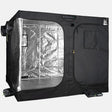
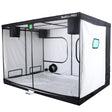
Leave headroom above the canopy: a 2.0 m (6.6') tall tent suits most light-and-duct stacks, and a grow cabinet gives a tighter, discreet footprint. We stock Trojan Silver tents plus Bloomroom and BudBox tents. A ready-made grow tent kit bundles tent, light and ventilation for a starter build.
How do you set up a grow tent, step by step?
Assemble from the outside in, so nothing blocks the next step:
- Frame: build poles and corners on a flat floor, then stand it up.
- Canvas: slide it over the frame and zip it shut.
- Floor: lay the floor tray or sheeting.
- Filter and fan: hang the carbon filter and extraction fan at the top, duct out of the tent and check every connection for leaks.
- Light: hang the fixture on adjustable hangers and plug it into the timer.
- Circulation and monitor: clip the fans on and place the probe at canopy height.
How do you size and hang your grow light?
A light is measured by what it delivers to the canopy — PPFD, in µmol/m²/s — not the wattage on the box. These are common starting ranges; follow your light maker's chart too:
| Stage | Target PPFD (µmol/m²/s) | Notes |
|---|---|---|
| Seedling / clone | 100–300 | Low intensity; too much light stresses young plants |
| Vegetative | 300–600 | Robust leaf and stem growth |
| Flowering | 600–1,000 | The most demanding stage; drives yield |
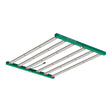
Buy one dimmable fixture rated to your tent's footprint at flowering PPFD, then dim it for seedlings and veg; the Omega Infinity 300W LED has full dimming. An LED still adds heat, though far less than old HPS lamps. Put the light on a timer: the Superlux Heavy Duty Grow Light Timer has a built-in contactor. Browse our LED grow lights or the wider lighting collection.
How do you size extraction, intake and circulation?
Extraction is the most important number in the build, because it removes heat, humidity and odour at once. Exchange the tent's volume (length × width × height) roughly once a minute: a 1.2 m × 1.2 m × 2.0 m (4' × 4' × 6.6') tent baselines near 173 m³/h (about 102 CFM) before headroom for the filter, ducting and light heat. Our ventilation guide has the allowances; buy a speed-controllable EC or DC fan comfortably above your figure.
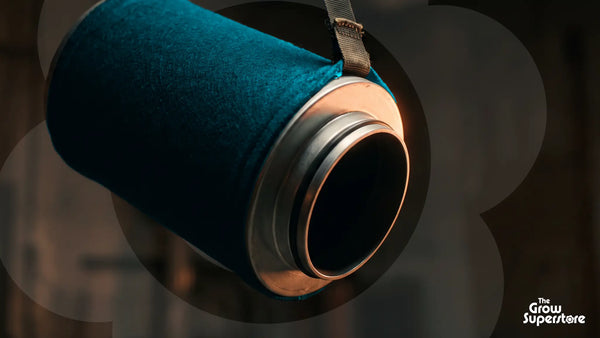
Give the tent an intake opening 1.5–2 times the exhaust area, and match the carbon filter's rated airflow to the fan's output. Filters wear out, so replace them on the maker's schedule (see odour control). Grab a matched fan and filter kit and the guesswork goes: the Systemair RVK fan and CarboAir filter kit pairs fan, filter and ducting. Or buy separate intake and outtake fans, carbon filters and ducting.
For circulation, add one or two clip fans to move air across — not blast — the canopy: the CLOUDRAY S6 (6 in, 15 cm) or CLOUDRAY S9 (9 in, 23 cm), or any air circulator.
How do you dial in climate — temperature, humidity, VPD and CO₂?
Temperature, humidity and VPD are three views of one climate, so target them as a set, with the sensor at canopy height:
| Stage | Temp, lights on °C (°F) | RH (%) | VPD (kPa) |
|---|---|---|---|
| Seedling / clone | 22–25 (72–77) | 65–80 | 0.4–0.8 |
| Vegetative | 24–28 (75–82) | 50–70 | 0.8–1.2 |
| Early flower | 24–26 (75–79) | 40–50 | 1.2–1.5 |
| Late flower | 24–26 (75–79) | 30–40 | 1.2–1.6 |
Run nights roughly 2–8°C (4–14°F) below your lights-on figure, and lower humidity as plants mature to keep grey mould out of dense flowers. Our temperature, humidity and VPD guides cover each. Close gaps in order: extraction and a circulation fan first, then a dehumidifier, an ultrasonic humidifier or a fan heater (see humidity control). Damp, stagnant air also invites mould and pests, so read our pest and disease prevention guide.
CO₂ enrichment — raising CO₂ above the roughly 420 ppm in outdoor air (NOAA's record), usually to 800–1,500 ppm — comes last, and only in a sealed room with a strong light already dialled in. See the CO₂ guide and the CO₂ control collection.
How do you monitor and automate the finished room?
Start with one accurate probe thermo-hygrometer at canopy height, and add automation only as problems demand. A controller reads sensors and drives your fans, heater and humidifier to your targets. Build up in order: a probe hygrometer for a simple start, then a thermostatic fan speed controller, then a full multi-device controller from the AC Infinity range. Our monitors and controllers guide walks the full ladder.
How should you budget a grow room setup?
Cost depends on tent size and how much you automate, so think in three tiers rather than a single total.
| Tier | Best for | What's in it | Where to spend first |
|---|---|---|---|
| Starter | First grow, small tent (0.6–1.0 m) | Small tent, one dimmable LED, fan and filter kit, clip fan, probe hygrometer | Extraction and light |
| Mid | A committed 1.2 m tent | 1.2 m tent, quality LED, speed-controllable EC/DC fan and filter, circulation fans, dehumidifier or heater, smart hygrometer | Climate control |
| Advanced | Sealed 1.5 m+ room, near-automated | Sealed tent, premium LED, EC fan with multi-device controller, CO₂ kit, dehumidifier and heater | Automation and monitoring |
Two rules save the most money: buy extraction and filter as a matched kit, and buy one dimmable light instead of a cheap fixed one you outgrow. For the wider first-timer list, see our first shopping list.
How does your setup change with the seasons?
Autumn and winter turn the problem from heat to cold and damp; the same kit handles both if you adjust how you run it.
- Autumn and winter: cold UK nights stall growth, so a thermostatic heater holds lights-off temperatures while you turn extraction down to keep warmth in. Cold air holds less moisture, so watch humidity in veg. Our winter grow room guide goes deeper.
- Summer: the tent becomes the hottest spot in the house, so run extraction harder, pull intake from the coolest room and run lights overnight to catch cool night air (see the temperature guide).
- All year: slower winter growth means lighter, less frequent feeds and faster summer growth means more, so pair climate with a full-cycle feeding schedule.
FAQ
What do you need to set up a grow room? Six things, in order: a light-proof grow tent, a dimmable grow light, an extraction fan with a carbon filter, one or two circulation fans, climate control (dehumidifier, humidifier or heater as needed) and an accurate thermo-hygrometer.
How much does it cost to set up a grow room in the UK? It depends on tent size, light quality and how much you automate. A small starter build costs a fraction of a sealed, near-automated 1.5 m+ room, so pick your tier first.
What size grow tent should a beginner get? A 1.2 m × 1.2 m (4' × 4') tent is the most popular all-rounder — it holds a small canopy under one LED and fits most spare rooms. If space is tight, a 0.6–1.0 m tent works; for a bigger harvest, step up to 1.5 m × 1.5 m (5' × 5').
Do I need CO₂ for my grow room? No — CO₂ enrichment is the last thing to add, not a starter item. It only pays off in a sealed room where your light, temperature and humidity are already dialled in, lifting CO₂ from the roughly 420 ppm in outdoor air to a room target of about 800–1,500 ppm.
What order should I buy grow room equipment in? Buy in the checklist order: tent, light, extraction, circulation fans, climate control, then monitoring. Each purchase sizes the next, so you avoid mismatched fans, filters and lights.
Recommended kit and further reading
- Tents: Trojan Silver, Bloomroom, BudBox and grow tents and sheeting.
- Light: LED grow lights.
- Air: fan and filter kits, intake and outtake fans and air circulators.
- Climate: humidity control, CO₂ control, AC Infinity climate control and fan speed controllers.
- Extras: propagation equipment and grow room tools.
Most relevant collection: if you only click one link, start with Fans, Filters & Environment; extraction and climate are where most setups live or die.
Related guides: temperature · humidity · VPD · ventilation · odour control · CO₂ · monitors · feeding schedule · shopping list.
Why trust The Grow Superstore
We've helped UK indoor growers since 2009, both online and from our physical store at 6 Wulfric Square, Bretton, Peterborough PE3 8RF. Kitting out grow rooms from a bare corner to a finished, monitored space is the conversation we have across the counter every week, so the sequence and sizing above come from real builds, not a spec sheet. Pop in for a free consultation, or get in touch and we'll help you spec a complete setup around your space, plants and budget.

New guides every week
Grow Room Environment
Temperature, humidity, VPD and airflow — dialling in the climate your plants live in
Browse all Grow Room Environment guides