Pots, Fabric Containers and Transplanting Without Stress
A fabric pot lets air reach the root zone through its walls so root tips are air-pruned instead of circling. Pot up gradually — a plug or 1L for seedlings, one size at a time — and transplant when roots reach the pot's edges, not on a fixed date.

On this page
Which pot should you use, and when should you transplant? A fabric pot is a soft, breathable container made from non-woven fabric that lets air reach the root zone through its walls, so root tips are "air-pruned" at the edge instead of circling. For most indoor plants, pot up gradually — a plug or 1L (0.25 gal) for seedlings, stepping up one size at a time — and transplant when roots reach the pot's edges, not on a fixed date.
Container choice isn't just about volume. Fabric and air pots change how roots grow, how fast the medium dries, and how hot the root zone runs in a summer tent. This guide covers pot-size progression, fabric vs air vs plastic, the summer dry-out question, and how to move a plant on without checking its growth.
Who this guide is for: UK home and hobby indoor growers choosing pots and potting seedlings or cuttings up into their final containers.
What pot size does your plant need, from seedling to final container?
Match the pot to the plant, not the plant to a big pot. A seedling in a large, wet mass of medium is a classic mistake — the Royal Horticultural Society calls it overpotting, where the fresh compost sits "wet for a long period, reducing aeration around the roots", so roots rot instead of growing out. Start small and step up as roots fill each pot.
| Stage / plant size | Pot volume | Why this size |
|---|---|---|
| Seedling or fresh cutting | Plug, module or ~1L (0.25 gal) | Small volume warms fast and dries evenly, so young roots establish quickly |
| Established young plant | ~3L (0.8 gal) | Step up once roots fill the first pot; the RHS advises going only 2.5-5cm (1-2in) wider each time |
| Vegetative growth | Pot on one size at a time — the RHS advises no more than one-third larger each step | Where most root expansion happens; step up as roots fill each pot rather than jumping ahead |
| Final container | ~11-30L (3-8 gal) | Size to the plant and your space — a bigger pot supports a bigger plant but needs more water |
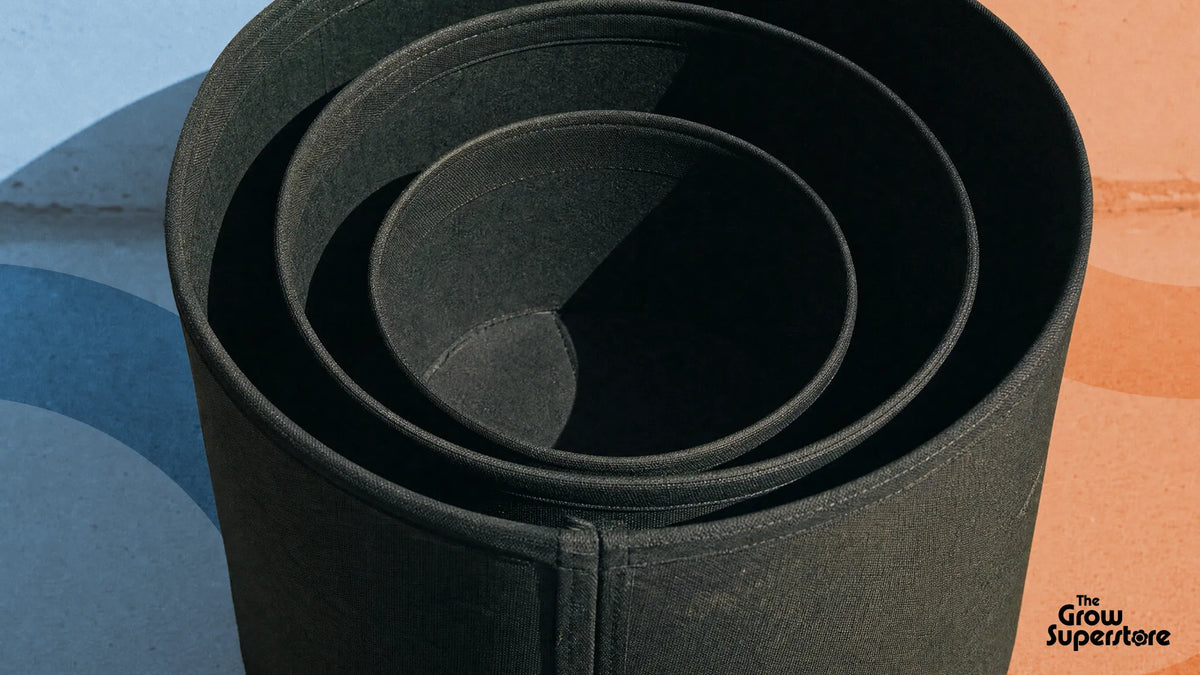
Air-Pot's own potting-on advice follows the same logic: start in a seed tray or a 1L pot, move a well-established seedling to a 3L, then into the final container — a tomato "will happily go from a seed tray to a 20 litre and stay there for the whole season." The Grow Superstore's round fabric pots run from 1L to 30L, so one range covers the whole progression.
Medium and container interact, too — a coco grower waters far more often than a soil grower in the same pot — so read our guide to choosing a growing medium alongside this one.
Fabric pots vs air pots vs plastic — what's actually different?
An air pot is a rigid plastic container whose wall is moulded into cones tipped with open air holes, so roots are guided to the holes and pruned by the air. A rigid plastic pot has a solid, smooth wall. Those three wall types behave very differently.
| Feature | Fabric pot | Air pot | Rigid plastic pot |
|---|---|---|---|
| Root behaviour at the wall | Air-pruned through the fabric — roots stop and branch inward | Air-pruned at the cone air-holes — roots stop and branch | Roots hit a solid wall and circle, becoming root-bound |
| Aeration to the root zone | High — the whole wall breathes | High — perforated cone wall | Low — mainly the surface and base holes |
| Drainage | Through the fabric everywhere | Through the holes and base | Through base holes only |
| Summer dry-out | Fastest — evaporates through the wall | Fast — evaporates through the holes | Slowest — holds moisture longest |
| Root-zone temperature in heat | Cooler — heat escapes the breathable wall | Cooler | Warmer — can bake in a hot tent |
| Reuse and storage | Folds flat; many can be machine-washed | Unclips and stores flat; lasts for years | Reusable but bulky to store |
The headline trade-off: fabric and air pots give you healthier, more fibrous roots and cooler summer running, but you'll water more often. Plastic is cheap and low-maintenance but leaves you managing root circling. For root health, a fabric or air pot is the better default — just be honest about how often you can water.
How do fabric and air pots "air-prune" roots?
In a solid plastic pot, a root grows until it hits the wall, then turns and follows it round — over time that spiral becomes a congested, root-bound ball that struggles to take up water and nutrients. In a breathable pot, the root tip meets dry, oxygen-rich air at the edge instead. As Air-Pot's makers put it, "Air dehydrates the tip, prunes it and stimulates root branching," building "a mass of healthy fibrous roots." The Grow Superstore's fabric pots work the same way: "The porous material encourages air pruning, which stops root circling by drying exposed tips naturally," producing "a denser, fibrous hydroponic root system that supports better nutrient uptake."
It isn't a fringe idea, either — the Royal Botanic Gardens, Kew grows more than 3,000 different plant species in Air-Pot containers, which shows how well air pruning holds up across a huge range of plants.
Do fabric and air pots really dry out faster in summer?
Yes — and it's the biggest thing to plan for. Water evaporates through the whole wall of a fabric pot (or an air pot's many holes), so the medium dries faster than in sealed plastic. As Garden Myths' Robert Pavlis explains, the outer 2.5-5cm (1-2in) of medium next to the fabric wall stays much drier — exactly what drives the air pruning, but also why the pot needs water more often. In a warm UK grow tent that can mean daily watering, or twice daily at the height of summer with a big plant in a smallish pot.
The flip side is a genuine seasonal bonus: heat escapes through the breathable wall, so fabric and air pots run cooler than plastic in hot weather and help protect roots from heat stress. Our grow tent temperature guide covers the airflow side of summer heat. To ease the watering load, don't undersize the pot — a slightly larger container buffers more water — and consider a gravity-fed automatic watering system for summer.
When should you transplant, and how do you avoid transplant shock?
Transplant on the plant's signals, not the calendar. The RHS lists roots "spiralling around the bottom and sides of the rootball" and roots "growing out through the holes" of the base as the tell-tales that a plant is pot-bound and ready to move up.
| Signal | What it tells you | What to do |
|---|---|---|
| Roots spiralling around the base and sides of the rootball | Pot-bound — the roots have run out of room | Pot up one size now |
| Roots growing out through the drainage holes | Pot-bound and searching for space | Pot up one size now |
| Medium dries out much faster than it used to | The root mass has outgrown the water the pot can hold | Plan the pot-up; water more often meanwhile |
| Growth stalled despite good feeding and climate | Often a congested, root-bound rootball | Slide the rootball out and check before feeding harder |
To move a plant on without checking its growth:
- Water the plant beforehand. A moist rootball holds together and slides out cleanly; a dry one crumbles and tears roots.
- Prepare the new pot first. Part-fill it with fresh medium so the plant sits at its old depth.
- Ease the plant out gently. Support the stem, tip the pot, and let the rootball come away.
- Only tease congested roots. Loosen tightly spiralled outer roots; otherwise disturb the rootball as little as possible.
- Backfill and firm. Firm the fresh medium lightly "to remove air pockets," as the RHS puts it.
- Water in. Water until it runs from the base so the medium settles against the roots.
Step up gradually rather than jumping to a huge final pot — the RHS advises a new container "no more than one third larger" than the last, or 2.5-5cm (1-2in) wider for smaller pots, so the medium doesn't sit cold and waterlogged around a small rootball. If you're moving rooted cuttings out of a propagator, our propagation guide covers hardening off before the first pot-up.
Do you need trays and saucers under your pots?
For fabric and air pots, yes — more than with plastic, because they weep through the base and lower walls. A saucer under each pot catches routine runoff; for a tent or a row of pots, a shallow spill tray or flood-and-drain tray copes with the heavier runoff from watering to drainage and lets you water freely in summer without pooling. Match the tray to the pot's footprint so it catches the drips.
FAQ
Are fabric pots better than plastic? For root health, usually yes. Fabric pots air-prune roots and keep the root zone better aerated and cooler in summer, giving a denser, more fibrous root system than a solid plastic pot, where roots circle and become root-bound. The trade-off is that fabric pots dry out faster, so you'll water more often.
Do fabric pots dry out too fast? They dry faster than plastic because water evaporates through the whole wall — testing shows the outer 2.5-5cm (1-2in) of medium stays much drier. In a warm summer tent that can mean daily watering. Sizing the pot correctly and using an automatic watering system both take the pressure off.
What size pot should I start a seedling in? Start small — a plug, module or around a 1L (0.25 gal) pot for a seedling or fresh cutting. A small volume warms and dries evenly so young roots establish quickly, whereas a seedling in a large, wet pot is prone to overpotting and root rot. Step up to roughly 3L once roots fill the first pot.
How do I avoid transplant shock? Water the plant beforehand so the rootball is moist, ease it out intact, disturb it as little as possible, step up only one pot size (the RHS suggests no more than one third larger), firm the fresh medium to remove air pockets, and water in well. Transplanting when the plant is established but not yet severely root-bound also reduces the check to growth.
Can you reuse fabric and air pots? Yes. Fabric pots fold flat and many can be machine-washed and reused across several seasons; air pots unclip, store flat and last for years. Kew reports reusing its Air-Pot kits for ten years or more.
Recommended kit and further reading
Here's the container kit we'd point a UK indoor grower to:
- Black Round Fabric Pots — breathable, foldable and reusable, in sizes from 1L to 30L, covering the whole potting-on progression.
- Grey Round Fabric Pots — the same breathable, air-pruning fabric pot in a grey finish.
- Pots & Saucers — fabric, plastic and speciality pots plus matching saucers to catch runoff.
- Large Trays — spill and flood-and-drain trays for tents and multi-pot setups.
- Media, Pots & Trays — pots, trays and growing media together when kitting out a space from scratch.
Most relevant collection: if you only click one link, start with Pots & Saucers — that's where the right container lives.
Related guides: Soil vs Coco vs Hydro · Propagation Masterclass: Seeds, Cuttings and Clonex Step by Step · Grow Tent Too Hot? Summer Temperature Control
All UK orders over £50 ship free (UK mainland, exclusions apply).
Why trust The Grow Superstore
We've been helping UK indoor growers since 2009, both online and from our physical store in Peterborough. Potting on and rescuing root-bound plants is advice we give across the counter every week, so the guidance above comes from watching what actually works — which pot sizes people come back happy with, and where overpotting quietly stalls a crop. Pop into the store for a free in-store consultation and we'll help you pick the right pots and trays for your plants and your space.