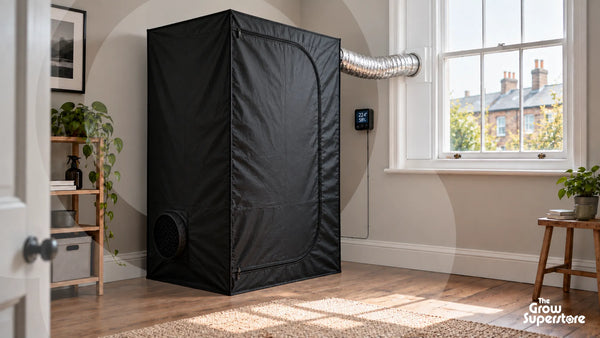
Grow Room Odour Control: Carbon Filters, ONA and What Actually Works
Match a carbon filter to your extraction fan's airflow, replace it every 12-24 months, and keep humidity under 70% RH. Use ONA gel outside the tent for stray smells, never inside.


On this page
How do you stop a grow room smelling? Fit a carbon filter for your grow tent, matched to your extraction fan: it removes odour at source, which nothing else does. Keep the filter's airflow rating above the fan's output, replace the filter every 12-24 months, and use ONA gel to neutralise stray smells outside the tent. Masking sprays only add perfume.
A carbon filter is a cylinder packed with activated carbon that strips odour molecules from the air a fan pulls through it.
Odour is the grow room problem your neighbours notice before you do, and half the "fixes" sold for it don't remove a single odour molecule. Here's what actually works, and where ONA earns its place.
Who this guide is for: UK hobby growers who want a tent or room that smells of nothing, without paying for kit that only covers the problem up.
How does a carbon filter actually work?
An activated carbon filter works by adsorption: as air passes through the carbon bed, odour molecules stick to the carbon's surface and stay there, so the air leaving the filter is clean. It's a physical trap, not a fragrance: nothing is added to the air, the smelly compounds are removed.
The reason a small cylinder can scrub a whole room is the material. Activated carbon is riddled with microscopic pores, giving a single gram an internal surface area in excess of 500 m² (5,400 sq ft), roughly two tennis courts in every gram. And the scrubbing happens fast: filter manufacturer Prima Klima states that a contact time of just 0.05-0.2 seconds between air and carbon is enough to deal with odours. Force air through faster than the bed's rating, though, and you cut that contact time.
Bed depth and carbon quality are what you're paying for. The CarboAir 50 uses a 50 mm (2 in) carbon bed suited to typical home tents, while the CarboAir Pro 60 steps up to a 60 mm (2.4 in) bed for longer contact time in smellier, more heavily planted spaces.
What size carbon filter do I need for my grow tent?
Match the filter to your fan, not to your tent. The filter's rated airflow must be at least as high as your extraction fan's maximum output, and UK retail guidance recommends around 20% higher, so the fan never forces air through the carbon faster than it can scrub.
Worked example: a 150 mm (6 in) fan rated at 560 m³/h (330 CFM) needs a filter rated at 560 m³/h or more. The CarboAir 50 150/330 is rated at 600 m³/h (353 CFM), so it clears that minimum. To keep the full 20% headroom, turn the fan down to about 500 m³/h on a speed controller instead of running it flat out.
| CarboAir 50 filter (flange/length) | Flange diameter | Rated airflow |
|---|---|---|
| 100/330 | 100 mm (4") | 410 m³/h (~241 CFM) |
| 125/330 | 125 mm (5") | 480 m³/h (~283 CFM) |
| 150/330 | 150 mm (6") | 600 m³/h (~353 CFM) |
| 200/660 | 200 mm (8") | 1,350 m³/h (~795 CFM) |
Two checks before you buy. First, match the flange diameter to your fan and ducting: a 150 mm fan wants a 150 mm filter, and brand doesn't matter, so a 150 mm filter clamps onto any 150 mm fan, AC Infinity included. Second, size against the fan's maximum output, not its usual running speed.
Fan size comes first; the full method is in our grow room ventilation guide. A second tent-sized option is the Rhino Hobby 30. To skip the sums, the Systemair RVK fan and CarboAir kit and the Whispair mixed flow fan and filter kit are matched pairs.
How long do carbon filters last?
A carbon filter typically lasts 12-24 months of continuous use: towards 24 in a warm, dry, lightly loaded room, as little as 6-8 where odour is heavy and constant. G.A.S. rates the CarboAir Pro 60 for a minimum of 18 months of effective use.
No gauge tells you a filter is spent: the test is your nose. The day you can smell the exhaust air, the carbon is done, so replace it. Smell also builds faster in autumn and winter, when tents run sealed with extraction turned down, so check your filter's age before the cold months (see our winter grow room guide).
| What shortens filter life | Why | What to do |
|---|---|---|
| Humidity at or above ~70% RH | Water molecules lodge in the carbon pores. CAN-Filters warns against running filters for long periods at or above 70% humidity | Fix humidity first, using our humidity control guide |
| Fan output above the filter's rating | Air moves through too fast for the 0.05-0.2 s contact time carbon needs | Size the filter ~20% above the fan's maximum |
| Dust and plant debris | Clogs the pre-filter sleeve and carbon surface | Wash the sleeve regularly (spares: CarboAir 50 sleeves); AC Infinity rates its pre-filter cloths for up to six months |
| Running 24/7 with nothing to scrub | Carbon adsorbs background VOCs from ordinary household air | Run it through smelly stages, not from seedling day one |
That humidity ceiling is invisible but decisive, so keep monitoring RH well below the 70% mark. Prima Klima's guidance is blunt: activated carbon filters work very well below 55% RH, performance drops from 60% RH upwards, and good performance can't be guaranteed above 70% RH.
Inline or recirculating: which scrubber setup do you need?
Inline extraction is the standard setup. The filter hangs at the top of the tent; the fan pulls air through it and out through ducting. That suction keeps the tent under slight negative pressure, so all air leaves through the carbon rather than leaking from zips and vents. Keep the filter on the suction side: air gets scrubbed before it touches fan or ducting.
Recirculating scrubbing is the backup pattern. A fan-and-filter pair sits inside a sealed room and cycles the room's own air through the carbon, with no exhaust. It suits sealed, CO₂-enriched rooms, or knocking down ambient smell in a garage, but it removes no heat or humidity, so it complements extraction rather than replacing it.
Do ONA gel and blocks actually work?
Yes, for the right job. ONA is a genuine odour neutraliser, not an air freshener: essential odour-neutralising oils suspended in a polymer gel, made by Odorchem since 1995. As the gel evaporates, its compounds bind with odour molecules through adsorption, absorption and chemical reaction, so the smell isn't hidden, it's chemically dealt with.
The critical rule: keep ONA out of the grow space itself. Its vapour is strong enough that air shared with plants in flower can taint the aroma of the crop you've spent months on. Use it where stray smell escapes to (the hallway, the room around the tent, beside the zip), never inside the tent.
| Method | How it works | Best for | Won't do |
|---|---|---|---|
| Carbon filter + fan | Traps odour molecules on activated carbon at extraction | The grow space itself: removal at source | Nothing outside the exhaust path |
| ONA gel / block | Evaporating compounds bind and neutralise airborne odour | Rooms around the grow; blocks suit small spaces | Won't scrub a flowering tent alone; must not share air with flowers |
| ONA liquid (diffused) | Concentrate diluted and dispersed as a fine mist | Larger ambient spaces; rapid knock-down | Same in-tent restriction as the gel |
| Masking sprays / air fresheners | Layer fragrance over the odour | A few minutes of cosmetic cover | Removes nothing: both smells remain |
For continuous, heavy-duty coverage, the ONA Cyclone Fan actively disperses gel vapour and holds up to 20 kg (44 lb) of gel.
How do you use ONA gel?
Put the tub where stray smell escapes: beside the tent zip, in the hallway or on a shelf in the room around the grow. Take the lid off for full strength, or part-open it to make a tub last longer. Start with one tub per room and add another only if smell lingers. Blocks suit tighter spots, and the ONA Air Filter holds them in a ducting run, downstream of your carbon filter and outside the tent.
What's the best odour-control setup for a UK grow room?
In order of priority:
- A carbon filter matched to your extraction fan. It removes odour at source; nothing else here works without it.
- Negative pressure in the tent. Extraction slightly stronger than intake, so all air exits through the filter (see our ventilation guide).
- Humidity under control. Keep RH off the ~70% ceiling so the carbon can work.
- ONA gel or a block outside the grow space. It neutralises the stray smell that escapes when you open the tent.
- No masking sprays. Skip them: they add a second smell instead of removing the first.
FAQ
Why does my grow room still smell with a carbon filter? The usual culprits: spent carbon (filters last roughly 12-24 months), a fan overpowering the filter's rated airflow, humidity at or above ~70% RH, or air bypassing the filter because the tent isn't under negative pressure. Check filter age first.
Can you clean a carbon filter? You can wash the outer pre-filter sleeve, and should, since dust chokes airflow. The activated carbon bed itself cannot be washed or refreshed at home. Once the carbon is saturated, the filter (or the carbon, in refillable designs) must be replaced.
Do carbon filters work in high humidity? Poorly. Manufacturers state performance drops above 60% RH and can't be guaranteed above 70%, because water molecules occupy the pores that should trap odour. Fix humidity before blaming the filter.
Can I use ONA gel inside my grow tent? No. ONA's neutralising vapour is strong enough to taint the aroma of plants in flower if it shares their air. Place it outside the grow space and let the carbon filter handle the tent itself.
Do I need ONA if I have a carbon filter? Not for the tent itself: the carbon filter handles everything that leaves through the exhaust. ONA earns its place for the smell that escapes when you open the tent or lingers in the room around it. Use the filter for the tent and ONA outside it.
Recommended kit and further reading
Here's the odour-control kit we'd point a UK grower to:
- CarboAir 50 Filter: 50 mm (2 in) carbon bed; the right choice for most home tents.
- CarboAir Pro 60 Filter: 60 mm (2.4 in) bed, rated for a minimum of 18 months; for smellier, heavily planted spaces.
- Fan & Filter Kits: matched pairings that remove the sizing guesswork.
- ONA Gel: neutralising gel for the rooms around your grow.
- ONA Block: small-space neutralising for hallways, cupboards and ducting runs.
Most relevant collection: if you only click one link, start with Carbon Filters, the full scrubber range from compact tent filters to deep-bed workhorses. That's where odour control begins and ends.
Related guides: sizing your extraction fan and ventilation · grow room humidity control · summer temperature control · grow room setup checklist.
Why trust The Grow Superstore
We've been helping UK indoor growers since 2009, online and from our physical store in Peterborough. Odour is the question we're asked most often, and the first thing we ask back in store is always "what's your fan rated at?" More often than not, a smelly tent is a sizing or filter-age problem, not a mystery. Pop in to 6 Wulfric Square, Bretton, PE3 8RF for a free in-store consultation and we'll match a filter to your fan and space.
Also explore

New guides every week
Grow Room Environment
Temperature, humidity, VPD and airflow — dialling in the climate your plants live in
Browse all Grow Room Environment guides