Hydroponic Systems Compared: DWC, Drip, NFT, Aeroponics and AutoPot
DWC, drip, NFT, aeroponics and AutoPot compared on cost, skill and upkeep. AutoPot and DWC are the easiest UK starts, while aeroponics grows fastest but demands the most skill.

On this page
Which hydroponic system should you choose? A hydroponic system grows plants in a nutrient solution instead of soil, feeding the roots directly with water, dissolved nutrients and oxygen. For most UK beginners, AutoPot (gravity-fed, no electricity) or DWC (roots in oxygenated water) are the easiest starts. Drip systems scale flexibly, NFT suits leafy crops, and aeroponics delivers the fastest growth but demands the most skill. Choose by budget, crop and how hands-on you want to be.
Who this guide is for: UK home and hobby growers deciding which hydroponic system to buy first, or moving up from soil or coco. New to hydroponics altogether? Start with our beginner's guide, then come back here.
Every system here trades simplicity for performance, and no single one is "best": the right pick depends on your crop, your space and how hands-on you want to be. Below is a straight, UK-focused comparison of the five mainstream home systems, with an honest downside for each.
Which system is easiest for beginners?
- Easiest and most forgiving: AutoPot.
- Cheapest way in: DWC.
- Leafy greens and herbs: NFT, once you have some experience.
What is a hydroponic system, and how does it work?
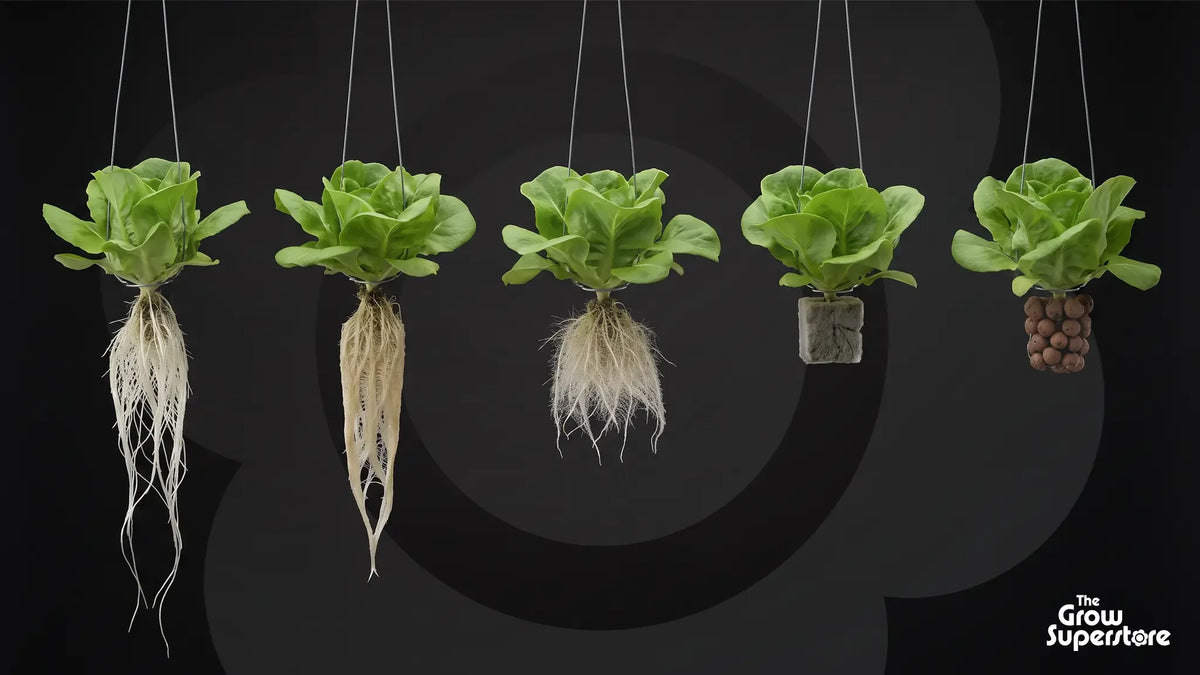
A hydroponic system delivers water, nutrients and oxygen straight to the roots with no soil in between. Because roots don't have to fight through compacted medium to find food, growth can be fast, and because the solution is captured and reused rather than draining away, these systems can use far less water than soil growing. You can grow almost anything hydroponically, but fast, thirsty crops such as leafy greens, herbs, tomatoes and peppers suit them best. Slow, woody or very large plants are usually happier in a pot of coco or soil (see our guide to choosing a growing medium).
The catch is oxygen. Roots need to breathe, and warm water holds less dissolved oxygen: solution at 24°C (75°F) holds roughly 20% less oxygen than the same water at 18°C (64°F). Every well-designed system solves this differently: DWC bubbles air through the reservoir, NFT runs only a thin film so roots stay half in air, and aeroponics skips standing water entirely and mists the roots. Get oxygen right and hydroponics rewards you; get it wrong and roots suffocate or rot.
The five hydroponic systems, ranked for UK home growers
Here they are in rough order of how easy they are to live with, easiest first. Every one still needs you to manage pH and nutrient strength, and that never goes away (see our pH, EC and water quality guide).
- AutoPot: gravity-fed pots that water themselves from a raised reservoir, with no pumps and no timers. The most forgiving system here.
- DWC (Deep Water Culture): roots hang from a net pot into nutrient solution, kept alive by an air pump and air stone bubbling oxygen through the water 24/7. Cheap, simple and fast-growing, but unforgiving of a warm reservoir.
- Drip (Wilma-style): a pump on a timer feeds each plant through its own dripper, and run-off returns to the tank. Endlessly flexible, and it works with clay pebbles, coco or soil.
- NFT (Nutrient Film Technique): a pump pushes a shallow, continuous film of nutrient down sloped channels, with roots half in the film and half in air. Efficient and clean for salad crops, but wholly dependent on the pump.
- Aeroponics: nozzles mist the bare roots with a fine spray every few minutes inside a closed chamber. The highest oxygen at the root and the fastest growth of any method, but the most technical and the least tolerant of neglect.
DWC vs drip vs NFT vs aeroponics vs AutoPot: the full comparison
Cost is shown as relative tiers, not prices, because costs move with system size and brand. Use it to compare systems, not as a quote.
| System | Cost | Skill level | Maintenance | Yield potential | If the power fails | Best for |
|---|---|---|---|---|---|---|
| AutoPot | Mid-range | Low | Low: top up the reservoir, check the valve | High (very consistent) | Keeps working (gravity-fed) | Busy growers; sites with no power |
| DWC | Entry-level | Low–moderate | Moderate: water changes, keep it cool | High | Air stops; roots sit in solution as oxygen falls | Beginners wanting fast growth from a few big plants |
| Drip (Wilma) | Mid-range | Moderate | Moderate: check drippers, timer and pump | High | Feed stops; medium holds moisture briefly | Multi-plant grows; any medium |
| NFT | Mid-range to premium | Moderate–high | Moderate–high: watch flow, clean channels | Medium–high | Roots dry within hours | Leafy greens, herbs and salads |
| Aeroponics | Premium | High | High: clean nozzles, constant monitoring | Highest | Bare roots dry very fast | Experienced growers chasing speed |
The pattern is clear: the more performance a system offers, the less buffer it gives you when something fails. AutoPot and DWC hold a pool of water that keeps roots alive through a wobble; NFT and aeroponics do not, so their roots dry out fast the moment flow stops.
The standout figure for the top end: NASA's Spinoff programme reports that aeroponic growing (developed with AgriHouse for space research) used 98% less water than conventional farming while lifting crop yields 45–75% and producing 80% more dry-weight biomass per square metre than hydroponic or soil methods. That is the ceiling of soilless growing, but it takes high-pressure nozzles, tight control and no room for error.
What's the honest downside of each system?
Every system has one failure mode that bites hardest. Knowing it in advance is how you avoid it.
| System | Main failure mode | How to avoid it |
|---|---|---|
| AutoPot | The AQUAvalve5 float valve can clog with sediment or thick additives | Fit the AutoPot in-line filter and rinse the valve now and then |
| DWC | A warm reservoir or a stopped air pump starves roots of oxygen, so root rot follows | Keep the reservoir at 18–20°C (64–68°F); run the air pump 24/7 |
| Drip | Blocked drippers, especially on rich or additive-heavy feeds | Choose the right dripper (such as the Arrow dripper) and check lines each feed |
| NFT | A pump or power cut dries the thin film within hours | Get the channel slope and flow right; add a backup or alarm for valuable crops |
| Aeroponics | Nozzle clogging from mineral build-up; any downtime dries the roots | Filter the solution, clean nozzles on a schedule, build in redundancy |
Valve care, dripper maintenance and water changes are covered step by step in our automatic watering and reservoir management guide.
Which hydroponic system suits your grower profile?
Match the system to how you actually grow, not to the biggest yield claim.
| Your situation | Best-fit system | Why |
|---|---|---|
| Brand new to hydroponics | DWC or AutoPot | Cheapest and most forgiving ways to learn soilless growing |
| Busy, or often away | AutoPot | Waters on demand from one reservoir, no timer to fail |
| Many plants, or you want to switch medium | Drip (Wilma) | One system runs many pots in pebbles, coco or soil |
| Leafy greens, herbs, salads | NFT | A shallow film suits fast, light, quick-turnaround crops |
| Experienced and chasing maximum speed | Aeroponics | Highest root-zone oxygen and growth rate, if you can manage it |
DWC or AutoPot first? Across our counter in Peterborough, the honest answer is usually AutoPot for anyone who travels or forgets, and DWC for someone who will check the bucket daily and wants the cheapest start. If you are torn, choose AutoPot: a missed day costs you less.
What about wick, Kratky and ebb and flow?
Wick and Kratky are passive, with no pump or power, so they suit herbs and a head of lettuce but not thirsty crops. Ebb and flow floods a tray on a timer, then drains it back to the tank, much like drip.
Do you need to chill your reservoir?
Any system that holds a body of water, DWC especially, lives or dies by reservoir temperature. In a UK summer, a tank next to a warm grow light or in a hot tent drifts well past 22°C, so aim for 18–20°C (64–68°F) and act above 22°C (72°F), when oxygen is falling and root-rot pathogens start to get active. Siting the tank low and out of the light, insulating it and topping up with cool water all help, and in a heatwave a Hailea Reservoir Chiller or frozen bottles will do the job; for room heat, see our grow tent summer temperature guide. Autumn and winter flip the problem: solution that drifts below 18°C (64°F) is under the target range, and a CB Water Tank Heater keeps it steady. AutoPot sidesteps most of this: it holds only a shallow tray of solution rather than a deep pool around the roots, so it runs cooler and calmer than a bubbling DWC bucket, part of why it's so beginner-friendly. Full reservoir care is in our reservoir management guide.
Keep pH around 5.5–6.2 (most growers hold 5.8–6.0) and measure with a meter from our pH & EC testers. Renew the solution every 1–2 weeks.
What do we stock for each system?
Here's where a UK grower would start for each system:
| System | Where to start |
|---|---|
| AutoPot | Autopot 1 Pot Module Kit, the standard starting point for gravity-fed, power-free watering, plus the wider AutoPot range |
| DWC | Black Bucket With Lid and Hailea Adjustable Air Pump; more in Deep Water Culture and Air Pumps & Accessories |
| Drip | Dripper Systems and Parts |
| NFT | NFT Hydroponic Systems & Parts for accessories; pumps in Water Pumps & Heaters. Ask in store about channels |
| Aeroponics | Aeroponic Systems & Parts |
Most systems run on inert media like Canna Aqua clay pebbles or the Gold Label 60/40 coco and clay pebble mix; see our guide to prepping inert media and, for net pots and containers, pots and transplanting.
Most relevant collection: if you only click one link, start with Systems, Parts & Testers, the home for hydroponic systems and the meters that keep them healthy.
Ready to buy? See our first shopping list.
FAQ
Which is the easiest hydroponic system for beginners? AutoPot is the most forgiving: gravity-fed, no electricity or timer, and it waters plants on demand. DWC is cheaper and fast-growing but needs the reservoir kept cool and aerated. Both are far easier than NFT or aeroponics.
What is DWC in hydroponics? DWC stands for Deep Water Culture. Plant roots hang from a net pot into a reservoir of nutrient solution, kept oxygenated 24 hours a day by an air pump and an air stone. It is one of the simplest and fastest-growing hydroponic methods.
Do you need electricity for hydroponics? Most systems do: a pump keeps the solution moving and oxygenated, and drip and NFT setups usually add a timer. AutoPot runs on gravity alone, and passive wick and Kratky setups need no pump either.
Why do hydroponic plants get root rot? Warm, under-oxygenated water. Keep the reservoir at 18–20°C (64–68°F) and well aerated; our root-zone health guide covers prevention.
Can I switch systems later? Yes. Your meters, nutrients and inert media carry across, and the monitoring routine is the same. Only the plumbing changes, so start with the simplest system and move up once it feels easy.
Why trust The Grow Superstore
We've been helping UK indoor growers since 2009, both online and from our physical store in Peterborough. "Which system should I buy?" is one of the most common questions across our counter, and the honest answer we give every week is that it depends on the grower: a busy traveller wants an AutoPot, a beginner chasing a fast first crop wants a DWC bucket, someone growing trays of salad wants NFT. We set these systems up and troubleshoot them daily, so the advice above comes from watching what keeps people growing, not from spec sheets. Pop into the store for a free in-store consultation, or get in touch and we'll help you match a system to your crop, space and budget.