Hydroponics Starter Kit UK: Your First Shopping List
A UK beginner's hydroponics starter kit list: the nine core items to buy, the extras for going soilless, and budget, standard and premium setups.

On this page
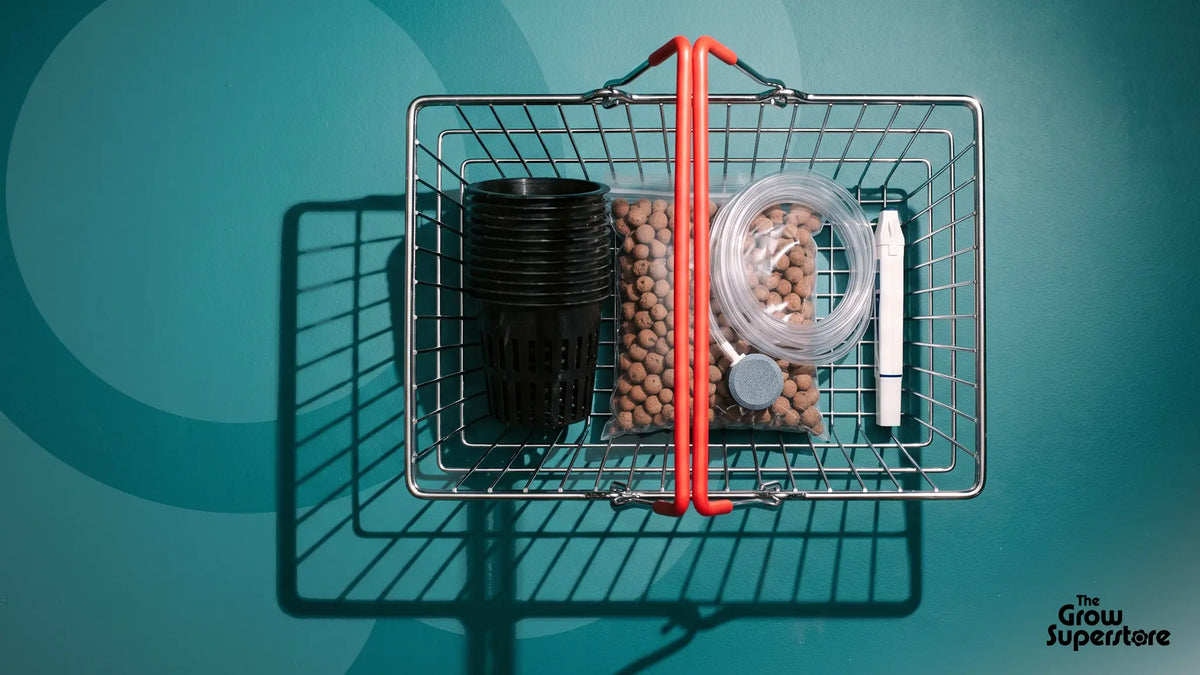
What does a hydroponics starter kit include? Nine things: a grow tent, an LED light, an extraction fan with carbon filter, a circulation fan, a growing medium, nutrients, a pH/EC meter, pots and a propagation kit. Going soilless adds a reservoir, an air pump with air stone and net pots. Below is each part, the order to buy in and how to pick a budget, backed by advice from a Peterborough store trading since 2009.
A hydroponics starter kit is the equipment a beginner needs to grow without relying on soil: a controlled space (tent, light, airflow) plus a growing medium, a nutrient feed and the meters to check it. Some shops sell the tent, light and fan as one boxed set; building from separate parts, as below, lets you match each one to your space. New to the idea? Our beginners' guide to hydroponics explains how it works.
Who this guide is for: UK beginners buying a first indoor grow or hydroponic setup who want a clear, sequenced shopping list.
What do you need to buy for a hydroponics starter kit?
The nine core items, in the order most beginners should buy them:
- Grow tent: a light-tight, reflective room you can control. Size it to your space; 60 × 60 cm (2' × 2') is the smallest sensible footprint, and the Trojan Silver Series starts there. For a 1 m × 1 m footprint, the Trojan Gold Series has a 100 × 100 × 200 cm size.
- LED grow light and a timer: the engine of growth and your biggest running cost. A Superlux Heavy Duty Grow Light Timer switches it on a fixed cycle. For a 1 m tent, a 300W unit such as the Omega Infinity 300W 2.7 Pro LED is the size we'd point a beginner to.
- Extraction fan and carbon filter: removes heat and odour and draws in fresh air. A fan and filter kit pairs them (the Systemair RVK fan and CarboAir filter kit comes with ducting) and a fan speed controller quietens them; sizing is in our grow room ventilation guide.
- Circulation fan: keeps air moving, strengthens stems and breaks up hot spots.
- Growing medium: what the roots live in. Coco and clay pebbles suit hydroponics (all media); soil vs coco vs hydro helps you choose, and prepping inert media covers rinsing and soaking.
- Nutrients: a two-part grow and bloom feed is enough to begin. Choosing a nutrient line compares brands and plant nutrients explained covers N-P-K.
- pH and EC meter plus pH up and down: with no soil to buffer it, you must measure. Start with a Bluelab pH Pen and add an EC meter, or go straight to the Bluelab Combo Meter, the professional benchmark; our pH, EC and water quality guide gives the targets.
- Pots or net pots: fabric or plastic for coco and soil, net pots for hydro. Pots and transplanting covers sizes.
- Propagation kit: a humidity dome and rooting gel such as Clonex Rooting Hormone to start seeds or cuttings; see the propagation masterclass.
Going soilless? Add these three:
| Add-on | What it does | Where to look |
|---|---|---|
| Reservoir | A lidded, light-proof bucket or tank that holds the nutrient solution | Deep Water Culture |
| Air pump and air stone | Puts oxygen into the solution so roots do not drown | Air Pumps & Accessories, including the Hailea Adjustable Air Pump |
| Net pots | Hold the plant and medium above the solution | Deep Water Culture |
Finally, add a thermometer and hygrometer so you can see heat and humidity before the plants show it. A Hygrometer Temperature & Humidity Sensor With Probe or an Air Comfort Temp & Humidity Sensor does the job; our guides to grow tent heat and humidity control explain what to do with the readings.
Budget, standard or premium: which starter setup suits you?
There is no single right spend, so match the tier to your ambition. Cheapest first:
| Tier | What you get | Best for |
|---|---|---|
| Budget | 60 × 60 cm (2' × 2') tent, entry LED, basic fan-and-filter kit, one bag of medium, starter nutrients, a simple pH pen | First-timers, one or two plants, tight budget |
| Standard | 1 m × 1 m (roughly 3.3' × 3.3') tent, 250-300W LED, quality fan-and-filter kit with a speed controller, full base-nutrient line, propagator, separate pH and EC pens | Most home growers |
| Premium | Quality-brand tent such as BudBox or the Trojan Gold Series, premium LED, AC Infinity ventilation and climate control, full nutrient and additive programme, automated watering, a combined meter | Serious hobbyists chasing the best results with the least fuss |
Standard is where most home growers should start: reliable kit, room for several plants and nothing to replace within a season. The budget compromise is headroom, because entry fans and lights leave less margin when the room warms up.
The cheapest sensible start is a basic deep water culture bucket in a 60 × 60 cm tent: a lidded bucket, an air pump and stone, net pots, a small LED, a fan and filter, plus a pH pen and nutrients. It keeps the footprint small and the plant count to one or two while you learn the pH and EC routine. Browse Deep Water Culture parts and tents in Grow Tents & Sheeting.
Running costs come mostly from the light. Multiply its wattage by the hours it is on and divide by 1,000 to get kWh per day: a 100W light on for 18 hours uses 1.8 kWh. Multiply that by the rate on your electricity bill.
Does winter change what you buy?
Yes, a little. In autumn and winter your light doubles as a heater, so a tent often stays warm enough, but a cold room may need a small tent heater. Keep a hydroponic reservoir at or above 18 °C (64 °F) with a reservoir heater from Water Pumps & Heaters. For heating and condensation, read our winter grow room tips.
Where can you buy hydroponic supplies in the UK?
From a specialist that can size the tent, light, fans, media, nutrients and meters to match each other. That is what The Grow Superstore does: we've supplied UK indoor growers since 2009, online and from our Peterborough store. A marketplace will happily sell you a fan too small for your tent or a light that cooks it; a dedicated grow shop sizes the kit as a system. If you're near Peterborough, bring your measurements in for a free consultation.
Lighting and system hardware are where a specialist earns its keep. For lights, browse LED grow lights and the wider lighting range; modern LEDs run cooler and cheaper than old HPS, which matters in a warm British loft. For airflow, a matched fan and filter kit or an AC Infinity system handles heat, odour and humidity together.
If you want a proper hydroponic system rather than pots of medium, deep water culture and AutoPot setups are the friendliest starts. The Autopot 1 Pot Module Kit waters from a single tank once set up and can be extended with more pots, and our systems, parts and testers range covers the rest. We compare every option in hydroponic systems compared.
In what order should you buy and learn it all?
A first grow is a sequence of small decisions. This guide points to the deep dive for each stage; read them in order and you'll never be guessing.
| Stage | What you are deciding | Read next |
|---|---|---|
| 1. Choose your medium | Soil, coco or full hydro | Soil vs coco vs hydro |
| 2. Prep inert media | Soaking rockwool, rinsing pebbles | Prepping inert media |
| 3. Start your plants | Seeds or cuttings, and Clonex | Propagation masterclass |
| 4. Pot up | Fabric vs plastic, sizes, transplanting | Pots and transplanting |
| 5. Pick a system | DWC, drip, NFT, aeroponics or AutoPot | Hydroponic systems compared |
| 6. Automate watering | Gravity vs pumped, anti-siphon valves | Automatic watering and reservoir management |
| 7. Protect the crop | Gnats, mites, mildew, IPM | Pest and disease prevention |
Two further guides complete the picture: our complete grow room setup checklist for extraction, climate and monitoring, and our full-cycle feeding schedule for feeding week by week, seedling to flush. With this shopping list, they map the whole journey.
FAQ
Where is the best place to buy hydroponic supplies in the UK? Choose a UK specialist that lists sizes clearly and will help you match them to your space. The Grow Superstore has done this since 2009, online and from its Peterborough store, with a free in-store consultation before you buy.
How much does a beginner hydroponic setup cost in the UK? Tent size and light decide most of the spend, with nutrients, pots and meters a smaller share. A 60 × 60 cm tent with an entry LED is the cheapest sensible start; a 1 m tent is the usual step up. Running costs come from the light: multiply its wattage by hours on, divide by 1,000, then multiply by your tariff.
What do I need to start growing hydroponically? To get one plant growing you need a tent, a light on a timer, extraction, a growing medium, nutrients and a pH meter. The circulation fan and propagation kit follow within the first weeks, and a soilless system adds a reservoir, air pump and net pots.
Do I need a pH meter for hydroponics? Yes. With no soil to buffer it, the solution drifts and plants lock out nutrients when pH is off. In coco and hydro the target range is 5.5-6.2, and most growers hold 5.8-6.0. Test every time you mix or top up.
Is it better to buy a kit or separate parts? A boxed set is the simplest way to get parts that match. Separate parts give you control over each component, but you need to check that the fan and filter suit the tent and the light suits the space. Either route works if the sizing is right.
Most relevant collection: if you only click one link, start with Grow Tents & Sheeting, because every other part is sized from the tent.
Related guides: soil vs coco vs hydro · hydroponic systems compared · automatic watering and reservoir management · grow room setup checklist · full-cycle feeding schedule
Why trust The Grow Superstore
We've been helping UK indoor growers since 2009, online and from our physical store in Peterborough (6 Wulfric Square, Bretton, PE3 8RF). "What do I actually need to get started?" is the question we answer most across the counter, and the advice we give every week is the same: buy the setup as a matched system, a fan sized to the tent, a light that won't cook it, nutrients that suit the medium. We put these kits together daily; this list reflects what keeps first-time growers growing, not a spec sheet. Pop in for a free consultation and we'll build your first kit around your space and budget. Delivery is free over a set order value on UK Mainland orders (exclusions apply).